Cartoon Analysis Englisch: Aufbau, Formulierungen und ein Beispiel
Ein Cartoon trägt seine Meinung im Bild und schreibt sie selten aus. Auf dieser Seite liegt von Anfang an ein Beispielbild vor dir, und daran geht es weiter: erst die Mittel, mit denen der Zeichner arbeitet, dann die Reihenfolge, in der du sie aufschreibst, dann die englischen Formulierungen dafür.
Was die Aufgabe bei einem Cartoon verlangt
Ein politischer Cartoon (oft auch Karikatur genannt) verdichtet eine Meinung zu einem aktuellen Thema in ein einziges Bild. Der Zeichner formuliert seine These nirgends aus, er setzt sie aus Symbolen, Größenverhältnissen, Beschriftungen und Anspielungen zusammen. Diese Bauteile sollst du im Aufsatz freilegen: benennen, was der Zeichner tut, zeigen, was das beim Betrachter auslöst, und daraus die Botschaft formulieren. Eine reine Bildbeschreibung erfüllt den Operator analyse noch nicht; sie liefert das Material, an dem die Deutung ansetzt.
Wie weit du gehst, steht im Arbeitsauftrag. Bei analyse arbeitest du die Aussage heraus und belegst sie am Bild. Erst wenn zusätzlich evaluate, comment oder assess verlangt wird, folgt eine begründete Stellungnahme. Für Grund- und Leistungskurs ist der Aufbau identisch, der LK erwartet mehr Tiefe und Differenzierung. Im Abitur kam ein Cartoon in den Klausuren 2024 bis 2026 als Material neben einem Meinungsartikel vor, etwa als Ausgangspunkt einer Wahlaufgabe mit discuss. Die Analyse des Bildes ist dort die Grundlage deiner Stellungnahme.
Zur Begrüßung gibt es den Starter Guide als PDF. Kein Spam, jederzeit abmeldbar. Datenschutz
Sieh dir das Beispielbild an, bevor du weiterliest
Alles Weitere auf dieser Seite hängt an diesem einen Bild. Nimm dir eine Minute: Wer sitzt wo, wer bewegt sich wohin, und was steht geschrieben?
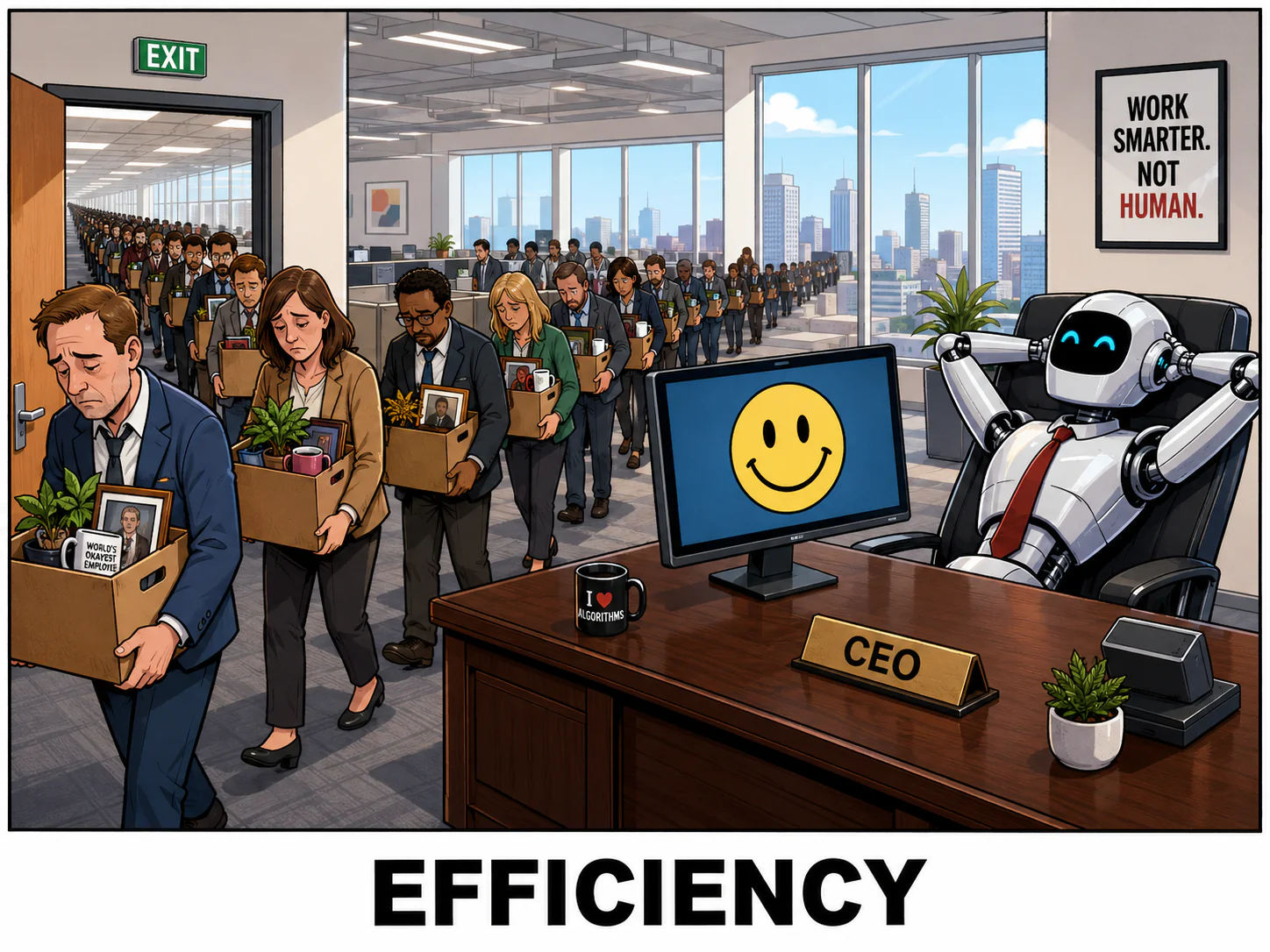
Cartoonisten arbeiten mit einem überschaubaren Repertoire. Diese fünf Mittel sind die gängigen Werkzeuge, und alle fünf stecken im Bild oben. Such sie dort, statt sie auswendig zu lernen.
Einleitung, Beschreibung, Deutung
Im Bild siehst du alles gleichzeitig, im Aufsatz musst du es nacheinander aufschreiben. Diese drei Teile leisten dabei sehr Unterschiedliches, und die Gewichtung liegt eindeutig auf dem dritten.
Einleitung (introduction)
Ein Satz, der Textsorte, Quelle (falls angegeben), Thema und Kernaussage nennt. Alles im Präsens. Hier gehört nur das Nötigste hin, keine Nacherzählung.
Beschreibung (description)
Sachlich und geordnet, vom Gesamteindruck ins Detail: Vorder- und Hintergrund, Figuren, Beschriftungen, Bildunterschrift. Noch keine Deutung, aber schon so ausgewählt, dass du im nächsten Schritt daran anknüpfen kannst.
Deutung (analysis and interpretation)
Der längste der drei Teile. Jedes Bildmittel wird mit seiner Wirkung verbunden: Was symbolisiert das Objekt, was bewirkt die Übertreibung, worauf zielt die Ironie? Daraus formulierst du die Botschaft und die Absicht des Zeichners. Das ist der Kern der Analyse (Anforderungsbereich II, kurz AFB II). Verlangt die Aufgabe zusätzlich eine Stellungnahme, etwa mit discuss, kommt AFB III dazu.
Das Beispielbild, in den drei Teilen durchgearbeitet
So lies das Folgende: Scroll beim Vergleichen ruhig noch einmal zum Bild hoch. Achte vor allem darauf, wie kurz die Einleitung ausfällt und wie viel Raum die Deutung bekommt.
1. Einleitung
The cartoon, entitled “Efficiency”, deals with the automation of the workplace and the human cost of replacing employees with artificial intelligence. It shows a robot taking over an entire office while its former human colleagues are being made redundant.
2. Beschreibung
In the foreground on the right, a white humanoid robot wearing a red tie leans back in an executive chair with its hands behind its head, looking completely relaxed. On the desk in front of it there is a nameplate reading “CEO”, a mug that says “I ♥ Algorithms” and a monitor that faces the viewer and displays one large, cheerful yellow smiley.
To the left, a long single file of downcast office workers in business clothing shuffles out through a door marked “EXIT”. Each of them carries a cardboard box filled with personal belongings, among them potted plants, framed photos and a mug reading “World’s Okayest Employee”. The queue stretches far into the background until it disappears. On the wall in the top right corner hangs a poster that reads “Work smarter. Not human.” The caption below the whole scene reads “Efficiency”.
3. Deutung
The whole cartoon is built on irony. The caption “Efficiency” and the beaming smiley on the screen celebrate the scene as a success story, yet what is actually shown is a mass layoff. This gap between the cheerful presentation and the grim reality is the cartoonist’s central device: it exposes how the language of progress can mask real human harm.
The exaggeration reinforces this. The queue of dismissed workers does not simply hold a handful of people, it recedes endlessly into the distance, suggesting that automation replaces not one job but a whole workforce. The cardboard boxes work as a symbol that any viewer recognises at once: they stand for being fired, for a working life packed away in a single container.
The labelling sharpens the message further. The nameplate “CEO” tells us that the machine has not taken over a low-skilled task but the very top of the company, and the red tie shows it stepping into a human role. The poster “Work smarter. Not human.” twists the familiar motivational slogan “work smarter, not harder” so that the smarter solution turns out to be getting rid of people altogether. Even the small details carry meaning: the mug “World’s Okayest Employee”, now boxed up and carried away, hints that being merely good enough is no longer enough to keep a human employed.
Through this contrast between the one comfortable, reclining machine and the many dejected humans, the cartoonist criticises the uncritical enthusiasm for artificial intelligence in the world of work. The message is that when companies celebrate “efficiency” above all else, technological progress and human progress are not the same thing, and the price is paid by the people who are quietly shown the exit.
All in all, the cartoon works as a warning. It reframes automation not as neutral progress but as a human loss dressed up as good news, and the deliberate clash between the cheerful surface (the smiley, the caption, the relaxed machine) and the grim reality (the endless line to the exit) leaves no doubt about the cartoonist’s stance: efficiency that ignores its human cost is nothing to celebrate.
Geh die Deutung oben noch einmal Satz für Satz durch: Jeder Satz benennt zuerst ein Bildmittel, beschreibt dann dessen Wirkung und bezieht sie am Ende auf die Botschaft. Diese drei Bewegungen in einem Satz zu halten, ist der Unterschied zwischen Beschreibung und Analyse. Den Abschluss bildet ein Fazit, das die Gesamtbotschaft benennt.
Useful phrases, sortiert nach den drei Teilen
- “The cartoon, entitled …, deals with the issue of …”
- “The cartoon addresses the topic of …”
- “In the foreground / background, we can see …”
- “On the right-hand side, a … is depicted.”
- “The caption reads …”
- “The cartoonist uses exaggeration in order to …”
- “The … symbolises / stands for …”
- “By labelling …, the cartoonist makes clear that …”
- “There is a striking contrast between … and …”
- “The overall message is that …”
Word bank für die Cartoon-Analyse
Ein großer Teil der Cartoon-Analyse besteht daraus, Bildpositionen und Stilmittel überhaupt benennen zu können. Diese Begriffe decken den Wortschatz ab, den du dafür brauchst.
Weiterlesen im Abi-Wissen
Dieselbe Analyse-Logik am Text: ethos, pathos, logos und die Stilmittel einer Rede.
Ansehen →Die Oberkategorie für alle nicht-fiktionalen Texte: Argumentation und Sprache freilegen.
Ansehen →Das gemeinsame Prinzip aller Analysen und der Wegweiser zu jeder Technik.
Ansehen →Die Analyse-Technik für literarische Figuren: direkte und indirekte Charakterisierung, am Text belegt.
Ansehen →Mehr Techniken wie diese?
Im Newsletter kommt jeden Monat ein Thema aus dem Englisch-Abitur NRW, kompakt erklärt und mit Beispielen. Dazu Hinweise, wo in der Prüfung Punkte verloren gehen, englische Formulierungen zum Übernehmen und ein Lerntipp. Zur Begrüßung bekommst du den Starter Guide als PDF, sobald du deine Anmeldung per E-Mail bestätigt hast. Abmelden kannst du dich jederzeit mit einem Klick.
Das ganze NRW-Abitur Englisch mit System.
Cartoon-Analyse ist eine von vielen Techniken, die im Abitur zählen. Operatoren, Textsorten, Analyse und die Themenfelder: Ich habe alles so aufbereitet, wie ich es im Unterricht erkläre und in der Korrektur sehe. Im Praxis-Guide steht das als Buch: 444 Seiten für 14,99 €, mit einer kompletten Übungsklausur für Grund- und Leistungskurs. Wer lieber geführt lernt, nimmt den Vollkurs mit seinen fünfzehn Modulen.
Oder erst einmal reinschauen: auf dem YouTube-Kanal.